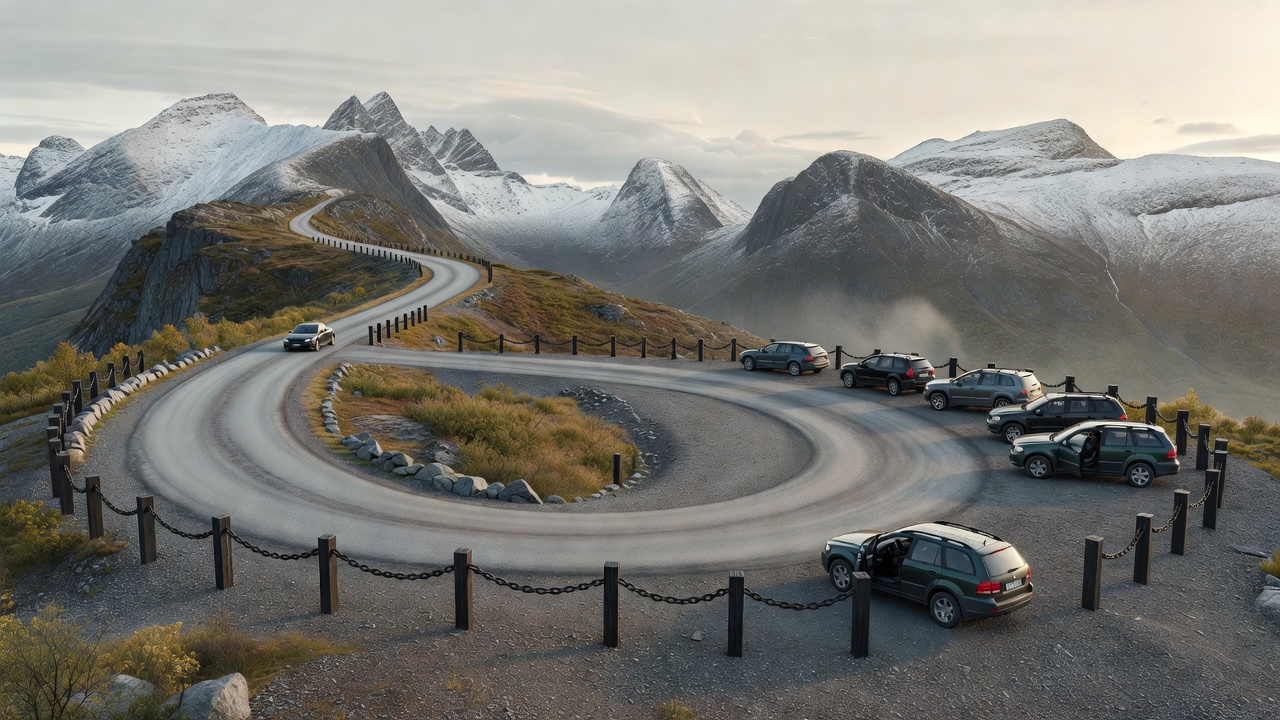
Choose the stopping place before the composition
Nordic roads often reveal a striking landscape at precisely the point where stopping would be least sensible: a blind bend, a narrow bridge or an exposed single-track section. Keep driving until you reach a lawful, suitable parking area. A hazard warning light does not turn an obstruction into a safe photo stop.
Passing places must remain available for traffic. Bus stops, private driveways, farm entrances and working quay access are not substitutes for a car park. Avoid soft verges and ground that could be damaged by your vehicle. If you cannot park fully clear of moving traffic without creating another problem, continue and enjoy the view as part of the drive.
Once parked, look at the walking route before stepping out with equipment. Do you need to cross a busy road? Is there a barrier or a marked path? Can children or less mobile companions use the space comfortably? The photograph should fit the stop, rather than the stop being forced to fit a photograph you saw online.
Mountain viewpoints: favour designed access
Norway’s scenic routes include purpose-built viewing areas, but a recognised name is not a guarantee of easy access on every date. Stegastein, above Aurland, illustrates the value of a designed viewpoint: the attraction is associated with a defined place to visit rather than an arbitrary roadside shoulder. Parking can still be busy, and the road requires attention.
Distinguish access to a particular viewpoint from access to an entire mountain route. A lower section may be open while a higher seasonal road is closed. Check the exact approach, not just a general destination search. On narrow roads, drive at a pace that allows you to meet traffic appropriately and use passing places for their intended purpose.
Weather can remove the view completely. Cloud is not a reason to wait in an unsafe position or climb past barriers. Have another nearby activity in mind so the journey does not depend on one clear panorama. A short walk in a sheltered location may offer a better day than staring into wind-driven mist.
Coastal viewpoints: read the exposure
Places such as Senja and the Varanger coast offer strong changes of horizon, from jagged silhouettes to low, open shoreline. That variety is part of their appeal, but coastal exposure can change quickly. Wind may affect your balance, opening a car door or the stability of a tripod well before it seems dramatic in a photograph.
Use established viewing areas where available and keep away from cliff edges, unstable ground and wave-washed rocks. A dry-looking surface is not proof that waves cannot reach it. Do not turn your back on the sea to arrange equipment close to the water. Local barriers and warning signs take priority over anything described in a travel guide.
Allow the coast to be more than a sunset target. Flat light, passing rain and a sheltered harbour can make thoughtful images without requiring an exposed headland. Choosing a modest, accessible stop often gives you more time to observe the place and less pressure to chase a particular sky.
Village, wildlife and landscape etiquette
In a small village, the attractive foreground may be someone’s home or workspace. Stay on public routes and ask before photographing identifiable people as the main subject. A long lens is not a substitute for courtesy. Avoid looking through windows, entering gardens or rearranging objects to improve a scene.
For wildlife, distance is part of the photograph. Use designated hides and viewing facilities where available. If an animal changes its behaviour because of you, increase your distance. Do not approach nests, use food to draw animals closer or block an animal’s route. Follow local restrictions even if other visitors are ignoring them.
Public access traditions differ between countries and do not generally create a right to drive across open land. They also come with responsibilities towards residents, livestock and sensitive habitats. Stick to appropriate paths, close gates when required and take all litter away. Keep precise locations of fragile or easily disturbed sites out of public geotags when sharing them could increase pressure.
Make photography fit the driving day
Choose one or two intentional photo stops rather than asking the driver to react to every view. Agree that passengers can notice possibilities, but the driver decides whether stopping is safe. Never handle a camera or phone while driving. If you want a particular light, stay nearby rather than adding a tired return drive at the end of a long day.
Keep batteries and a cleaning cloth accessible, but secure loose equipment before moving. Download any useful location information in advance and remember that a saved marker does not prove legal access. Drone use involves separate aviation, privacy, wildlife and site rules; this guide does not grant permission to fly.
- Park lawfully and leave access clear.
- Check the route from the vehicle to the viewpoint.
- Respect residents, wildlife, barriers and signs.
- Keep an alternative when weather hides the scene.
- Leave with no image rather than create a problem.